Pollution may be defined as addition of undesirable material into the environment as a result of human activities. There are, also, other definitions. Some of them are; → Pollution is the contamination of soil, water, or air by discharging harmful substances. → Pollution is the introduction of contaminants into an environment, of whatever predetermined or agreed upon proportions. This occurs when only short-term economic gains are made at the cost of the long-term ecological benefits for humanity. → Pollution is the effect of undesirable changes in our surroundings that have harmful effects on plants, animals and human beings. “Harmful” mean an adverse effect on adverse effect on anthropogenic or natural non-living structures, or a reduction in the air‟s visibility Pollution can happen in different form. o These contaminants, in general, cause instability, disorder, harm or discomfort to the physical systems or living organisms therein. The agents which cause environmental pollution are called pollutants. → Pollutants may be defined as a physical, chemical or biological substance unintentionally released into the environment which is directly or indirectly harmful to humans and other living organisms. → Pollutants can be classified into
Download Free PDF View PDF
Download Free PDF View PDF

Download Free PDF View PDF

Download Free PDF View PDF
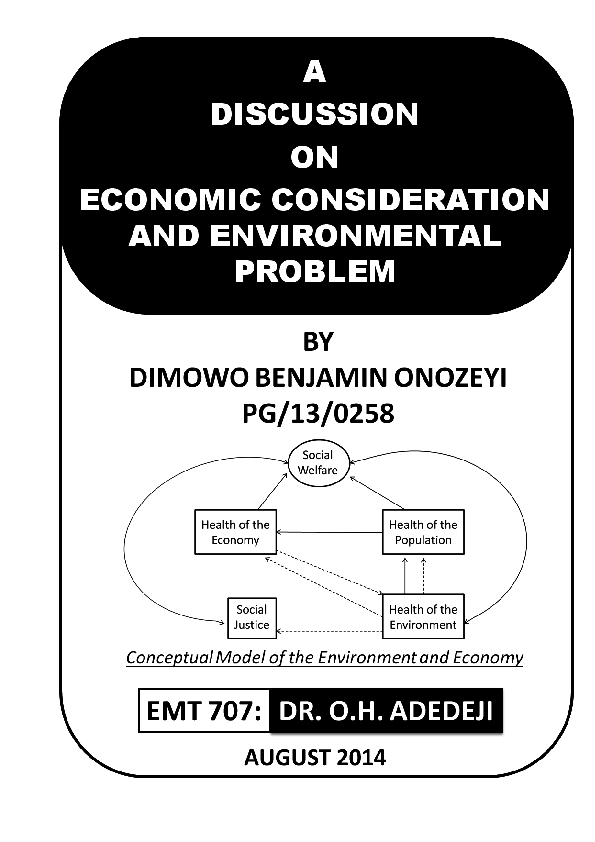
Pollution induces harmful effects on environment and health security. Main deep causes will be analyzed including natural disasters like volcanoes eruption, climate change as well as and men-caused disasters which are nuclear explosions and dioxin sprays.
Download Free PDF View PDF

The importance of the environmental pollution lies in its great impact on human life and the surrounding environment. In addition to its disastrous results that extend for many years, it contributes to crystallize the life of man, animal, and plant. The research discusses the concept of environmental pollution, and all the undesirable changes that occur in the environment. It sheds light on the causes of pollution, especially radiation and chemical types result from cars, fumes, gases, smoke and industrial wastes, which included liquid, solid wastes and others. It emphasizes air pollution, its causes, sources, and effects on humans, animals, plants, and the weather. It has a major role in making a foremost change in temperatures degree. Conceivably, the waste is extremely dangerous, and the smoke, fumes, toxins and unpleasant odors of factories and cars cause a fuel combustion with all its preventive measures and procedures. There is no doubt that the expansion of transportation means will negatively affect the percentage of environmental pollution. The research debates the most important factors and causes of water pollution due to throwing liquid and solid wastes into rivers and lakes. The causes of soil and plant pollution can be linked to the use of large quantities of pesticides and chemical fertilizers, which affect the quality of agricultural crops and reduces their fertility. They contribute to the loss of their beneficial organic materials, which harmfully disturbs the life of both humans and animals.
Download Free PDF View PDF

Modern economic development sometimes disrupts nature’s delicate balance. The extent of environmental pollution caused by humans is already so great that some scientist question whether the Earth can continue to support life unless immediate corrective action is taken. If left undisturbed, natural environmental systems tend to achieve balance or stability among the various species of plants and animals. Much of the world’s air, water and land are now partially poisoned by chemical wastes. Some places have become inhabitable. These pollution exposes people all around the globe to new risks from disease. As a result of these developments, governments have passed laws to limit or reverse the threat of environmental pollution. The 19th century, industrial revolution placed greater pressures on the environment. Although industrial development through the control of nature and development of new products improved the standard of living of humans, this was at a great environmental cost.
Download Free PDF View PDF
A series of documents on the economic and environmental problem written over several decades.
Download Free PDF View PDF

2022, abdulla moharm
The unsustainable form of resource use negatively affects resources and the economy as mentioned above. The resource may renew itself one time or more but its productivity is reduced till it reaches a point" threshold" at which no further treatment can replenish it, this point is called the ecological tipping point. The forest, mangrove, coral reef, and agricultural land may reach the tipping point in a certain region of unsustainable use and may not recover so it will result in ecological imbalance and economic problems. So, we had to properly manage the resource use correctly with studied plans to avoid resource loss and economic mess.
Download Free PDF View PDF
Download Free PDF View PDF

Sorry, preview is currently unavailable. You can download the paper by clicking the button above.
Download Free PDF View PDF

Download Free PDF View PDF
2019, Ndunagu K.c
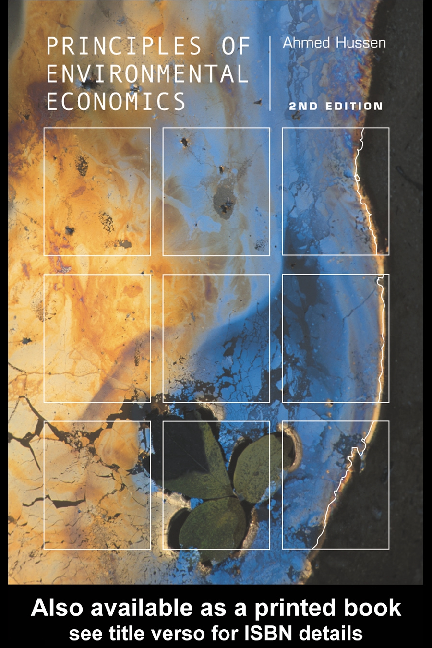
In recent developments on environmental resource management, analytical ideas of economics is used in making decisions about the use of environmental resource in a way to foster sustainability. Economics however, studies how humans make discission, while environmental economics draws from economic concepts to manage the natural environment. Environmental economics however draws its principles from both types of economics, but primarily from microeconomics (Chappelow 2019). Hence economic concepts are concerned with the fundamental issue of allocating scarce resources among competing users, environmental economics also draws its principles from the concepts of scarcity, opportunity cost, trade-offs, marginal benefits, marginal costs, efficiency and equity which are the key concepts if economics. These economic concepts however, can be applied in issues that arises from our natural environment like the atmosphere, water, land, and other variety of living species. In as much as economic decisions made by humans can be detrimental to the natural environment, like in dumping hazardous waste on the natural environment in other to save cost, we can mitigate this from using equitable and efficient use, drawn from environmental economic concept to manage our natural resource.
Download Free PDF View PDF

2020, Ecology, Economy and Society–the INSEE Journal
Download Free PDF View PDF

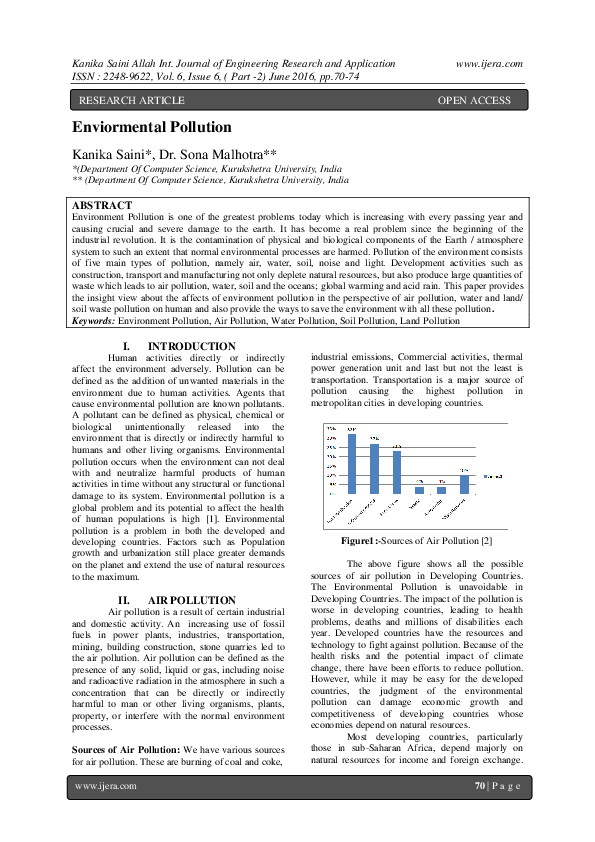
Environment Pollution is one of the greatest problems today which is increasing with every passing year and causing crucial and severe damage to the earth. It has become a real problem since the beginning of the industrial revolution. It is the contamination of physical and biological components of the Earth / atmosphere system to such an extent that normal environmental processes are harmed. Pollution of the environment consists of five main types of pollution, namely air, water, soil, noise and light. Development activities such as construction, transport and manufacturing not only deplete natural resources, but also produce large quantities of waste which leads to air pollution, water, soil and the oceans; global warming and acid rain. This paper provides the insight view about the affects of environment pollution in the perspective of air pollution, water and land/ soil waste pollution on human and also provide the ways to save the environment with all these pollution.
Download Free PDF View PDF
Download Free PDF View PDF

2022, Central Asian Journal of Theoretical and Applied Science
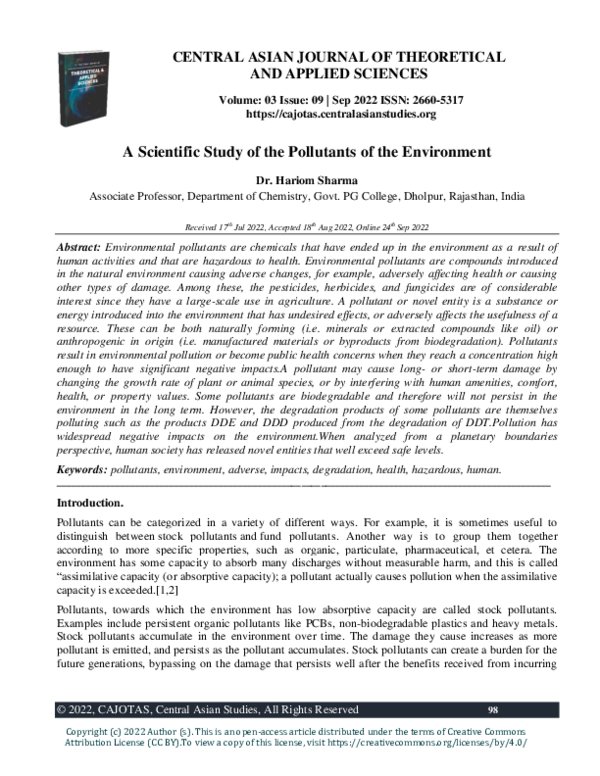
Environmental pollutants are chemicals that have ended up in the environment as a result of human activities and that are hazardous to health. Environmental pollutants are compounds introduced in the natural environment causing adverse changes, for example, adversely affecting health or causing other types of damage. Among these, the pesticides, herbicides, and fungicides are of considerable interest since they have a large-scale use in agriculture. A pollutant or novel entity is a substance or energy introduced into the environment that has undesired effects, or adversely affects the usefulness of a resource. These can be both naturally forming (i.e. minerals or extracted compounds like oil) or anthropogenic in origin (i.e. manufactured materials or byproducts from biodegradation). Pollutants result in environmental pollution or become public health concerns when they reach a concentration high enough to have significant negative impacts.A pollutant may cause long- or short-term damage by changing the growth rate of plant or animal species, or by interfering with human amenities, comfort, health, or property values. Some pollutants are biodegradable and therefore will not persist in the environment in the long term. However, the degradation products of some pollutants are themselves polluting such as the products DDE and DDD produced from the degradation of DDT.Pollution has widespread negative impacts on the environment.When analyzed from a planetary boundaries perspective, human society has released novel entities that well exceed safe levels.
Download Free PDF View PDF
2010, Annals of University of Craiova Economic Sciences Series
Download Free PDF View PDF
2022, ENVIRONOMICS: Economic Approach to Environmental Issues
The state of the environment is currently a major global problem. Pollution is considered a serious threat in industrialized countries, where the quality of life is measured by the growth of material production. Meanwhile, the environment has become a serious obstacle to economic development and poverty alleviation in developing countries. Humanity's relationship with the environment has gone through several phases, starting with primitive periods when people lived in a state of symbiosis with nature, followed by a period of increasing dominance of nature until the industrial age, and culminating in a rapid resource-consuming manner and the growth of the twentieth century, which affected natural resources in several ways. More recently, humanity's attitude toward the environment has evolved to include more active projects and policies to predict and minimize environmental degradation. In this context, many experts consider the concept of sustainable development and environmental economics as an evolving field of economics. Prior to the 1970s, little attention was paid to the growth and development of this field of knowledge in economics. The first oil crisis in 1973 and the subsequent occurrence of relatively high environmental damage on a global scale prompted scholars to apply economic tools to environmental science. Nowadays, people around the world have realized that the environment is not just a study of flora and fauna, but a synthesis of the study of different branches of knowledge, such as science, economics, philosophy, ethics, and anthropology. Therefore, environmental economics requires a detailed understanding of the various environmental factors, their impacts, and their functions for the environment and for human life in the present and in the future. The concept of sustainable development is an approach that allows for the improvement of the quality of life at a lower intensity of resource use, leaving future generations with an unchanged or even increased supply of natural resources and other values. Sustainable development is a key factor in creating added value and innovation, and at the same time can make a critical contribution to the economic development of individuals and society as a whole. In a free market and a well-functioning economy, it could strike a balance between economic prosperity, social cohesion, and the rational use of natural resources. The general impetus has been renewed by the success of the "Agenda 2030" and the Paris Agreement. At the same time, people around the world are beginning to worry about inequality, slow growth, job loss, and globalization, which is reflected in the stimuli of socio-economic difficulties. The Organization for Economic Cooperation and Development (OECD) aims to help countries sustain socio-economic growth through three key aspects: green "ecological" growth, inclusive growth, and productivity growth. The concept of green growth is able to provide a monitoring framework with a set of four broad groups of indicators and the strategy of economic transformation. The aim of these policies is to create a socio-economic and environmental system to assess the impact of economic activity on the environment. This publication deals with the link between the environment and the economy and is a partial output of two research projects entitled "Diffusion and consequences of green innovations in imperfect competition markets" and "Migration and the silver economy: economic, political and legal implications of tackling aging and population migration in EU countries". The aim of the publication is to assess the global competitiveness of countries from the perspective of the environmental economy in the context of sustainable development, taking into account all three levels: economic, social and environmental.
Download Free PDF View PDF
This is a draft chapter for K. Hartley and C. Tisdell, Microeconomic Policy, Second Edition. It is designed to illustrate how microeconomics can be applied to the analysis of issues involving the environment and the availability of natural resources and policies to address these issues. It outlines the micro-basis of a number of macro-environmental relationships, considers environmental externalities and their regulation, analyses some environmental relationships involving public goods or public bads, introduces the concept of total economic value and discusses the consequences of open-access and common property resources and policies to control their use.
Download Free PDF View PDF
